

AI News October 2025: Latest AI Updates, OpenAI News & Technology Trends
Introduction
AI News October 2025 stands out as an important moment in the history of artificial intelligence. It is a time when significant developments are taking place across enterprise AI, regulators, generative models, health innovation, education, and healthcare. The launch of new products, initiatives to improve policy, and investment in industry illustrate that AI is moving from a stage of experimental adoption to widespread commercial and public sector implementation.
Industry developments throughout October highlighted how leading technology companies expanded their AI capabilities as European Union and United States governments have increased AI governance by introducing new regulations. At the same time, healthcare organisations stepped up their use of AI-assisted diagnostics. OpenAI education news revealed the increasing importance of AI literacy, support for educators, and a responsible adoption of AI in classrooms.
This article explores the most important AI news from October 2025, its impact on businesses and society, and how it compares with AI developments from previous months. It also compares the most significant changes against AI News in July 2025 and Technology News in August 2025 and examines the most recent AI Regulation News Today (EU and US). Instead of merely summarising recent changes, this piece explores how important they are and how they will influence AI’s future direction.
Key Takeaways
- OpenAI introduced major AI updates for education and productivity.
- Enterprise AI adoption accelerated across industries.
- The EU and US expanded AI governance initiatives.
- Healthcare organisations increased AI-assisted diagnostics.
- AI literacy became a stronger focus in education.
Expert Analysis
The development of AI through October 2025 demonstrates the clear shift from isolated announcements of technology to widespread implementation in the real world. At the beginning of October, the focus was on the development of new products and business tools. As October progressed through the month, regulatory frameworks, healthcare applications, and educational initiatives were becoming more prominent, signalling a wider shift towards responsible AI adoption with scalable deployments and long-term integration across all industries. This timeline shows that the month of October 2025 was characterised not just by advancements in AI technology, but also by its increasing maturity as a key element of government, business, healthcare, and education. Overall, these developments show that October 2025 marked a significant shift from AI experimentation to practical, large-scale adoption across industries.
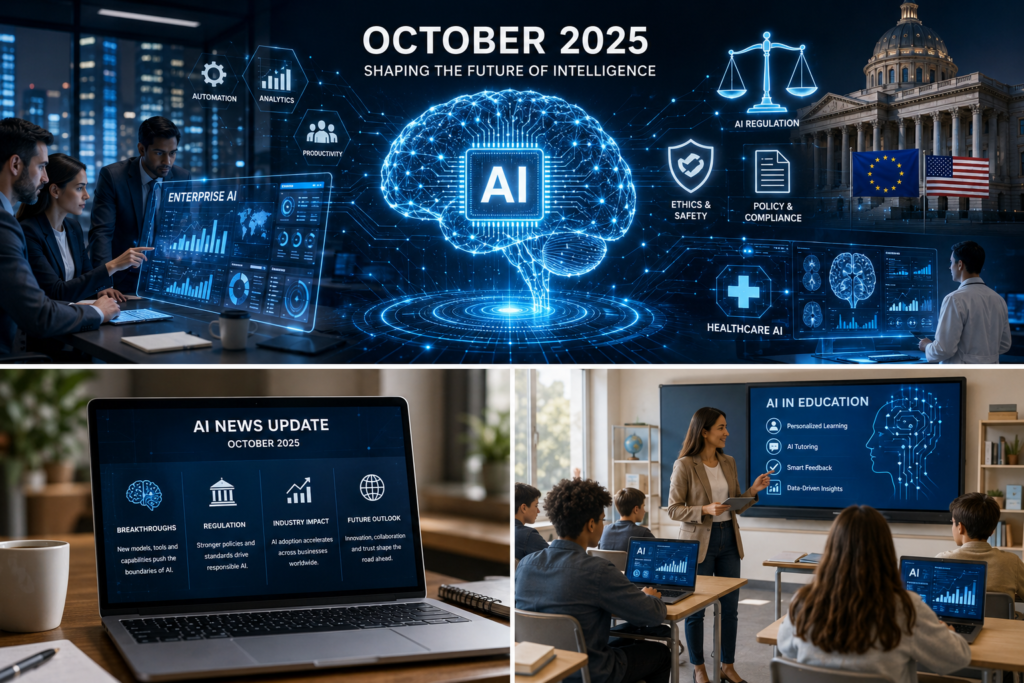
AI News October 2025 at a Glance
| Category | Major Update | Industry Impact |
| OpenAI Education News | OpenAI introduced new AI learning initiatives, educational tools, and platform enhancements. | Accelerated AI literacy, educator support, and responsible AI adoption in schools and universities. |
| Enterprise AI | Microsoft Copilot, Google Gemini, and NVIDIA expanded enterprise AI capabilities. | Improved workplace productivity, business automation, and operational efficiency. |
| Technology News August 2025 vs October 2025 | October 2025 built on the AI infrastructure and platform developments introduced in August, leading to broader enterprise adoption. | It demonstrated faster adoption of AI in enterprises and wider AI integration across all industries. |
| AI Regulation News Today (EU & US) | Both the European Union and the United States expanded AI governance through new transparency, compliance, and policy initiatives. | Stronger AI governance, improved transparency, and increased regulatory compliance. |
| Healthcare AI | AI-powered diagnostics and tools to support clinical decision-making continue to grow. | It increases diagnostic accuracy, improves patient outcomes, and accelerates medical research. |
The table gives a high-level summary of AI news in October 2025 across four areas: enterprise technology, regulation, healthcare, and education. These updates show that AI innovation is no longer driven only by new models. It is also shaped by wider industry adoption, evolving governance frameworks, and practical real-world applications.
Notably, OpenAI education news highlights the growing focus on AI literacy and the responsible use of AI in education. Similarly, AI regulation news (EU & US) reflects stronger efforts to improve transparency and AI governance. Together, these trends show that October 2025 marked a major step towards the mainstream adoption of artificial intelligence across industries.
Timeline of AI Developments in October 2025
| Timeline | Major Development | Why It Matters |
| Early October 2025 | OpenAI equipped AI capabilities for education, workflow automation, and generative AI applications. | Demonstrated AI’s growing role in productivity, learning, and enterprise adoption. |
| First Week | Microsoft, Google, and NVIDIA introduced new enterprise AI tools and infrastructure. | Enabled organisations to scale AI deployment and improve business automation. |
| Mid-October | AI adoption has accelerated across organisations, and organisations have moved from pilots to an organisation-wide implementation. | It marked the transition from experimental AI projects to organisation-wide deployment. |
| Mid–Late October | The European Union advanced AI Act implementation, while the United States expanded AI governance initiatives. | Increased and improved the focus on transparency, accountability, and responsible AI development. |
| Late October | Healthcare institutions have embraced the use of AI for diagnostics as well as clinical decision support systems. | It improved diagnostic efficiency and supported more data-driven healthcare decisions. |
| End of October | Educational institutions focused on AI literacy programmes and integrated AI-assisted learning tools into classrooms. | This highlighted the growing importance of preparing students and educators for an AI-driven future. |
Biggest AI Technology News of October 2025

OpenAI’s Latest Announcements
OpenAI announced several significant innovations in October 2025 that expanded the practical applications of generative AI for content creation, web browsing, and education. These updates demonstrate OpenAI’s continued dedication to building an integrated AI ecosystem that serves both individual users and enterprises alike.
Key Highlights
- Sora: Sora provides improved AI video generation with more realistic imagery, longer sequences, and greater creative control for users.
- Atlas Browser: An AI-native browser designed to simplify web browsing and automate online tasks.
- ChatGPT Improvements: Expanded reasoning capabilities, workflow automation features, and collaboration features designed for personal and enterprise use are now available on ChatGPT
- OpenAI Education News: Continued investment in AI literacy training, educator support services, and responsible classroom adoption is further demonstrating AI’s growing role in education.
Why It Matters
OpenAI’s recent developments demonstrate its shift away from chatbot technology towards an AI platform capable of supporting business productivity, education, and digital transformation.
Microsoft, Google & NVIDIA Updates
Microsoft, Google, and NVIDIA all released tools and infrastructure that enable organisations to deploy AI at scale, reflecting an increase in demand for intelligent automation and enterprise-grade AI solutions.
Key Highlights
- Microsoft Copilot Studio: Equipped with AI agents capable of automating business processes and increasing workplace efficiency.
- Google Gemini: Introduced with AI capabilities across search, productivity tools, and content generation to deliver more personalised user experiences.
- NVIDIA Enterprise AI Infrastructure: Provides advanced computing platforms and AI hardware designed to accommodate large-scale AI workloads and enterprise applications.
Key Insight
Microsoft, Google, and NVIDIA’s combined advancements indicate that enterprise AI adoption has reached a more advanced phase. Instead of solely investing in developing new AI models, these companies are investing in scalable infrastructure, intelligent automation platforms, and integrated AI platforms that enable organisations to deploy it securely and efficiently – this trend shows how enterprise AI has progressed from experimental implementations into long-term digital transformation strategies.
Amazon and Anthropic
Amazon and Anthropic have both put a strong focus on increasing operational efficiencies while creating safer, more dependable AI systems. Their recent announcements illustrate how these AI solutions are now being deployed in logistics, automation, and enterprise environments.
Key Highlights
- Amazon Warehouse Robotics: includes the use of AI-powered robots to improve inventory management, order fulfilment, and supply chain efficiency.
- Anthropic Claude Updates: It increases reasoning, safety mechanisms, and enterprise capabilities to support reliable AI deployment in regulated industries
Expert Analysis
These developments indicate that AI innovation in its next stage will prioritise scalable automation, reliable AI systems, and practical business applications across industries.
AI Regulation News Today (EU & US)
As AI advances at an unprecedented rate, its rapid expansion has necessitated effective regulatory frameworks that balance innovation with transparency and accountability. Both Europe and America unveiled policy initiatives in AI News in October 2025 aimed at strengthening AI governance, reflecting an international shift toward responsible development and deployment of artificial intelligence technologies.
European Union
The European Union recently continued its implementation of the AI Act, creating new transparency and compliance requirements for AI providers and developers. The regulatory framework focuses on risk-based governance; organizations must improve documentation, disclose AI-generated content where relevant, strengthen accountability for high-risk AI systems, and enhance accountability as necessary – these measures aim to establish a standardized approach to safe AI across member states.
United States
In the US, AI governance continued to place emphasis on innovation while expanding voluntary safety commitments and responsible AI practices. Government agencies and technology companies collaborated on AI safety, cybersecurity, and model evaluation, resulting in a balanced approach that supports technological progress without creating a comprehensive regulatory framework.
AI Regulation Comparison
| European Union | United States |
| AI Act implementation | Consists of executive initiatives and agency guidance |
| As well as a risk-based compliance framework | Innovation-driven governance needs are mandated |
| Mandatory transparency requirements in the EU | Voluntary safety commitments are in the US |
| There is strong regulatory oversight | There is public-private collaboration. |
Key Insight
The comparison demonstrates two distinctive approaches to AI governance. Whereas Europe prioritises legal compliance through AI Act legislation, the United States prioritises innovation supported by voluntary safety initiatives. Together, these strategies demonstrate how AI Regulation News Today (EU & US) is shaping global standards for responsible AI development while informing how businesses design, deploy, and govern artificial intelligence systems.
OpenAI Education News and AI Learning
ChatGPT for education
Educational institutions are rapidly adopting ChatGPT for education to enhance personalised learning, enhance research assistance, and offer instant academic feedback. Research indicates that AI-powered tools such as ChatGPT can increase student engagement while decreasing repetitive learning tasks; however, their use should only ever replace conventional instruction rather than become the sole basis for education.
AI literacy
AI literacy has quickly become a pivotal component of modern education. Schools and universities alike are adopting programs that equip their students to understand how artificial intelligence systems function, evaluate its output critically, and use AI responsibly. According to research findings, AI literacy helps develop digital competence while equipping them for life in an AI-powered economy.
Teacher support
Artificial intelligence is also transforming teaching by assisting educators with lesson planning, assessment creation, grading support, and classroom administration. Research shows that reducing administrative workload allows teachers to dedicate more time for student interaction, personalised instruction, and higher-value educational activities.
Why it matters
Responsible AI
As AI becomes a larger element of education, utilising AI in a responsible way is crucial. According to research in the field of education, responsible AI usage should prioritize students’ privacy, fairness, academic integrity, transparency, and trust between teachers and students. The application of these principles can help universities and schools utilise AI in a safe manner while establishing trust between them and their teachers and students.
Student productivity
AI-powered learning tools aid students in achieving better results by providing immediate explanations, customised feedback, and instant access to quality learning sources. The research suggests that these tools can cut down on the amount of time that is spent doing repetitive tasks, allowing students to concentrate more upon critical thought, imagination, and greater comprehension of the material they are studying.
Future workforce skills
The growing use of AI across all industries has altered the competencies employers look for in graduates. Research suggests that AI literacy, as well as digital collaboration, problem-solving, and making ethical choices, are now crucial workplace competencies. By integrating these competencies into the curriculum at colleges and universities, they will improve the preparation of students for an increasingly technological workforce and the future of career possibilities.
How October 2025 Compares with Previous AI News

AI news, July 2025
Early AI model release
The industry’s developments in June 2025 were mostly due to the introduction of the next generation of AI models that have enhanced understanding, multimodal capability, and the ability to code. Market analysis and research revealed that technology companies were focused on improving model accuracy, decreasing response time, and increasing support for enterprise-level applications. The early releases showed the continued importance of developing foundation models that can handle more difficult and specific tasks across a variety of industries.
Infrastructure investment
Alongside new model releases, AI infrastructure investments accelerated significantly during July 2025. Major cloud providers and technology companies expanded data centre capacity, invested in high-performance AI chips, and strengthened cloud computing infrastructure to meet growing demand for large-scale AI training and inference. Industry research suggested that these investments were essential for supporting future AI innovation, enabling organisations to deploy increasingly powerful models while improving scalability, reliability, and computational efficiency. This period established the technical foundation for the broader enterprise adoption that gained momentum in the following months.
Technology News August 2025
In the month of August 2025, the competition for AI-powered browsers grew as major tech companies introduced features such as AI-assisted searching and real-time summarisation of content, support for writing, and intelligent navigation on the web. An analysis of the market revealed that developers of browsers increasingly saw AI as a fundamental technology, indicating an overall shift towards the integration of the power of generative AI in everyday digital experiences.
Enterprise adoption
August also saw a dramatic growth in enterprises’ AI use. The research suggested that companies went beyond pilot programmes and began to incorporate AI into customer service development, developing software for document processing along with workflow automation. Companies focused on increasing efficiency in operations, reducing the manual burden, and increasing decision-making with AI-powered tools.
Stronger Enterprise Deployment
October 2025 saw AI implementation evolve further than previous months. Industry reports revealed that enterprises had expanded AI from departmental use cases to organisation-wide deployment, integrating it into core business operations and moving away from experimentation towards long-term strategies that offered commercial value and operational improvement.
October 2025 – Regulatory Developments
October also witnessed significant advances in AI regulation and governance. Policymakers introduced initiatives designed to enhance transparency, accountability and responsible AI deployment; research found that regulatory conversations increasingly addressed balancing innovation with ethical standards, risk management practices and public trust issues; this demonstrated that effective governance was becoming a necessary element for sustained AI adoption.
Key Trends Shaping AI After October 2025

Research and industry analysis suggest several long-term trends will impact the next phase of artificial intelligence adoption.
Rise of AI Agents: AI is quickly progressing from simple chatbots to autonomous agents capable of planning tasks, making decisions, and carrying out multi-step workflows without needing human interference.
Enterprise AI: Organisations should leverage AI across business operations, with particular attention paid to automation, productivity improvements and data-driven decision-making at enterprise scale.
AI Regulation: Governments and regulatory bodies could strengthen AI governance through policies that promote transparency, accountability, risk management and ethical deployment of artificial intelligence.
Healthcare AI: Healthcare sector projections indicate an anticipated surge in AI adoption for medical imaging, clinical decision support, drug discovery, personalised patient care, and efficiency, thereby improving efficiency and diagnostic accuracy.
AI Education: Education institutions must incorporate AI literacy into curricula while using AI-powered learning tools for personalised education and digital skill development.
Responsible AI: Researchers emphasise the importance of maintaining fairness, privacy protection, cybersecurity, transparency, and human oversight as crucial principles to ensure AI systems are deployed safely, ethically, and with public trust in mind.
Conclusion
The month of October 2025 is a crucial month for the advancement of artificial intelligence, as demonstrated by the increase in corporate deployment, growing regulatory initiatives, and broader adoption across healthcare, education, and business. Based on research findings, businesses should keep an eye on developments in the field of AI governance, implementation of new agent technologies, and accountable AI solutions that aim to create sustainable value for industries.
The coming months are expected to bring more responsible, scalable AI solutions tailored to different industries.
October 2025 demonstrated that artificial intelligence is no longer limited to experimental tools. Businesses, governments, healthcare providers, and educational institutions increasingly adopted AI for practical use cases. As AI regulation evolves and enterprise adoption grows, organisations that embrace responsible AI strategies will be better prepared for future innovation.
Frequently Asked Questions
What was the biggest AI news in October 2025?
The biggest AI news in October 2025 was the rapid expansion of enterprise AI adoption across industries, alongside stronger AI governance initiatives in the European Union and the United States. The month also saw significant OpenAI education updates, wider use of AI-powered healthcare diagnostics, and continued investment in business automation. Together, these developments highlighted AI’s shift from experimental technology to practical, large-scale deployment across multiple sectors.
How did AI regulation change in the EU and US?
In October 2025, policymakers across both the European Union and the United States developed AI governance by introducing new policy discussions and regulatory initiatives. The research suggested that these efforts focused on transparency and risk management, as well as ethical AI deployment and accountability. The goal was to promote technological innovation while establishing safeguards that encourage trust among the public as well as responsible AI adoption.
What is OpenAI doing in education?
OpenAI has continued to expand the use of AI in education, assisting individualised teaching, AI literacy, and the efficiency of teachers. Educational institutions have increasingly embraced ChatGPT for teaching of tutors and research, lesson planning, and academic assistance. The research suggests that these initiatives seek to improve the quality of learning while encouraging responsible AI use and helping students prepare for a future workforce based on AI.
How was October different from AI news in July and August 2025?
Compared with July and August 2025, the month of October 2025 was a more advanced level that was a more advanced stage of AI adoption. While July was focused on the latest AI models and infrastructure investment, and August focused on AI competitors in the browser and integration with enterprise systems and integration, October was a shift towards massive enterprise deployments and more robust regulatory frameworks. The research suggests that this shift was the beginning of a shift in the industry away from technological advancement towards an environmentally sustainable, well-governed, and commercially scalable AI implementation.