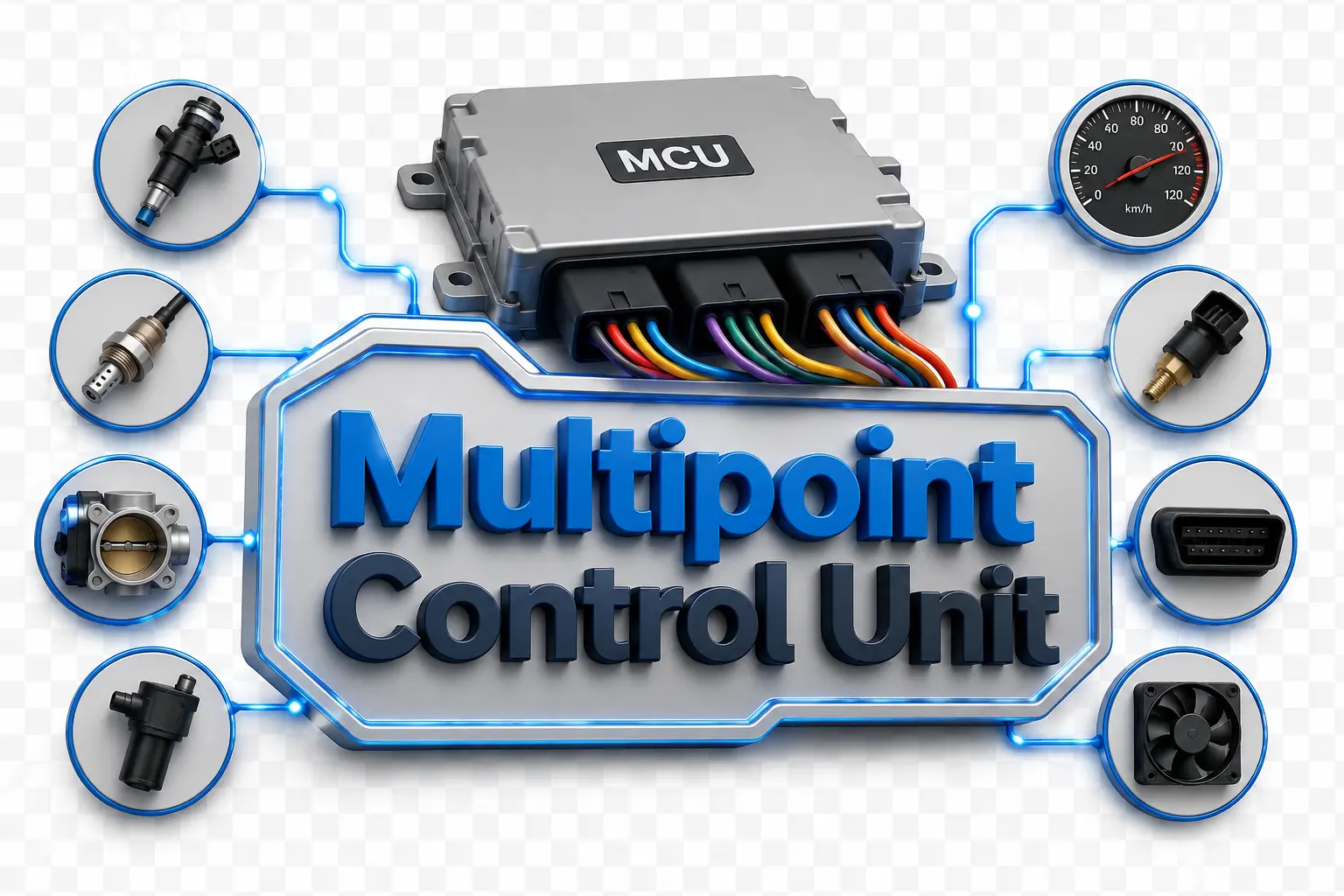
Multipoint Control Unit: Complete Guide to MCU Video Conferencing
A Multipoint Control Unit is the technology that enables group video calls. If you’ve ever been curious about how ten individuals from distinct offices can appear on the same display screen, use the same layout, and have an honest conversation, it’s not a matter of magic. An MCU is what performs the hard work.
In this guide, we’ll describe what the meaning of MCU is, how it functions while processing different video streams, and how it is still preserved despite recent technologies, for example, the emergence of SFUs.
The knowledge you gain here will help you understand the working principles behind the whole MCU system, when it is necessary to use hardware instead of software, and make you an expert in the field of video conferencing.
What Is a Multipoint Control Unit (MCU)?
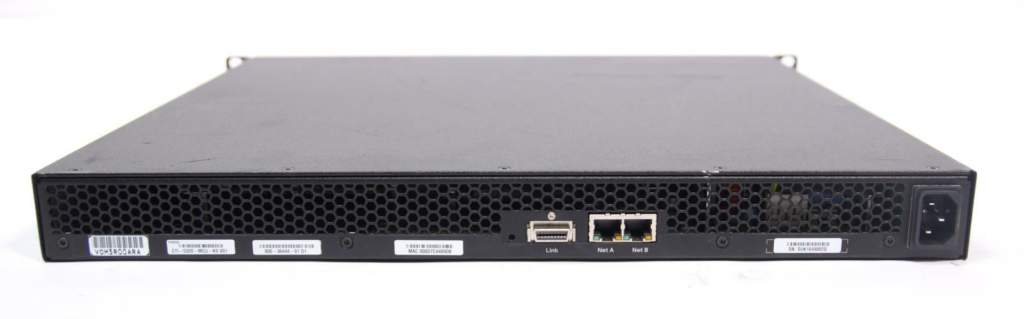
The Multipoint Control Unit is a hardware or software component that connects three or more endpoints into an online conference. Instead of every participant connecting directly to every other participant, each one connects to the MCU. So when the MCU is in use, it is responsible for figuring out how to merge all audio and video into a single stream.
The name of this device comes from the ITU-T H.323 standard, which is one of the first standards specifying multimedia conferencing at its core. In the absence of the MCU, group calls were inconvenient, ineffective, and available to only.
It should be mentioned that the MCU acts instead of just serving as a silent bridge – a bridge just sends traffic, but the MCU will decode, mix, and encode every single video stream it receives, which is far more complex; therefore, MCUs have become integral to conferencing systems.
How Does a Multipoint Control Unit Work?
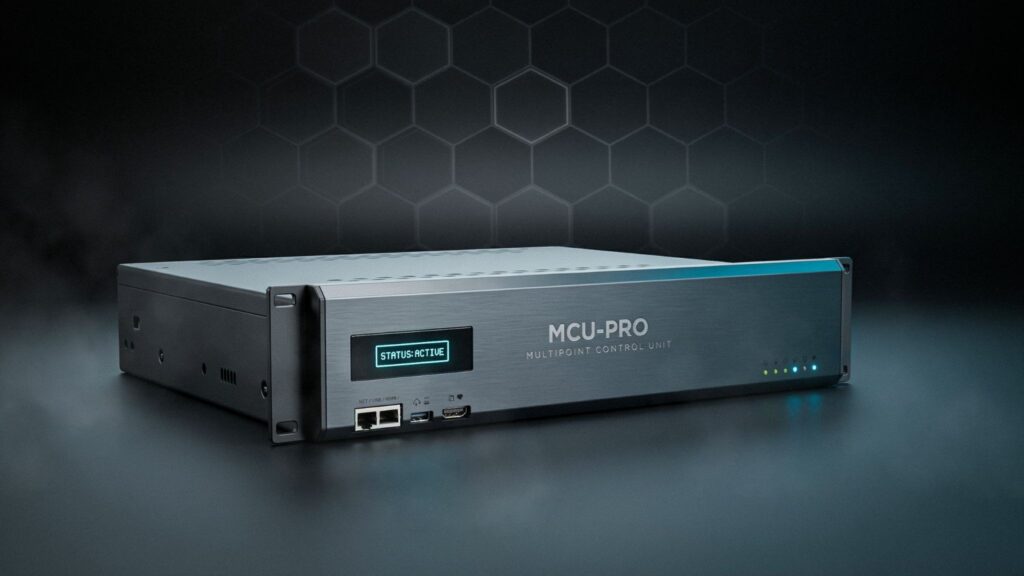
First of all, the MCU functions by collecting incoming streams from the users and combining them into a stream that is issued by the MCU.
Here’s the simplified flow of a typical call:
- Each endpoint has to contact the MCU to discuss its abilities (codec, resolution, bandwidth).
- The MCU decodes every incoming stream individually.
- It mixes the audio and composites the video into a layout.
- This feed is then re-encoded and sent back to all the users.
Two important components make the process possible: the multipoint controller (this is the signaling and call establishment component) and the multipoint processor (the real audio and video processing component).
Multipoint Control Unit Architecture and Core Components
The MCU architecture splits cleanly into two layers: signaling and media.
- Multipoint Controller (MC): It is in charge of establishing and terminating calls, as well as negotiating capabilities among endpoints. It may be viewed as an operator since it determines who is welcome to enter.
- Multipoint Processor (MP): Does the real work, decoding, mixing, transcoding, and re-encoding. This is the engine room.
Beyond MC and MP, most MCUs also include:
- A signalling layer (H.323 or SIP) that manages call control separately from the media itself
- A media layer carrying the actual RTP audio and video packets
- Gateway functions that translate between different protocols or network types.
This separation matters because it lets the MCU manage hundreds of connections without the signalling traffic interfering with actual audio or video quality.
How an MCU Processes Audio and Video Streams
This is where the real technical work happens, and it’s worth understanding in detail because it explains almost everything about MCU performance and cost.
- Decoding: Every incoming stream, from every endpoint, gets decoded individually. If eight people join, the MCU decodes eight separate streams simultaneously.
- Mixing (sound): The decoded sound is combined into one sound source with the help of a dominant-speaker logic.
- Compositing (video): The decoded video frames can be spaced out and become a part of a layout, a grid view, speaker view, or other customized forms.
- Transcoding happens when endpoints communicate with different types of signals, for instance, when one endpoint communicates in H.264 and the other one in VP8.
- Re-encoding: The final composed output gets encoded once per unique feed needed and sent back to each participant.
Pro tip: Transcoding load, not bandwidth, is usually the real bottleneck.
This decode-mix-encode pipeline is powerful, but it’s also CPU- and GPU-intensive, which is the root cause of most MCU scaling limitations discussed later in this guide.
MCU vs. Point-to-Point and Mesh Video Conferencing
Not every video conference needs an MCU. Understanding the alternatives makes it clear why MCUs exist in the first place.
| Model | Connections Required | Bandwidth Load | Processing Location | Scalability |
| Point-to-point | 1 direct link | Minimal | Endpoints only | Only 2 participants |
| Full mesh | Every endpoint to every other | Grows as N(N-1) | Endpoints only | Breaks down past 4-5 people |
| MCU-based | Each endpoint to MCU only | Roughly linear with N | Centralized at MCU | Scales to large groups |
In a full mesh setup, each additional person adds connections exponentially, which is why mesh conferencing becomes unusable fast. An MCU solves this by centralizing the processing, so bandwidth per endpoint stays predictable no matter how many conference participants join.
Types of Multipoint Control Units
Different types of MCUs serve different purposes. You will have to choose the one according to your budget and needs.
Hardware MCU
A hardware MCU is a purpose-built appliance with dedicated processing chips for media handling.
Pros:
- Predictable, low-latency performance
- High reliability for on-premises deployments
- Ideal for boardrooms and telepresence systems
Cons:
- High upfront cost
- Fixed capacity; you can’t scale past what’s installed.
- Considered legacy MCU technology by many modern IT teams
Software-Based MCU
A software MCU runs on general-purpose servers instead of dedicated hardware.
Pros:
- Flexible deployment and easier updates
- Lower entry cost than hardware
- Runs as a software conferencing server on standard infrastructure
Cons:
- Performance depends entirely on host hardware.
- Requires careful resource planning to avoid bottlenecks
Cloud-Based MCU
A cloud MCU delivers the same functionality as a hosted service, often as part of a broader video conference platform.
Pros:
- Elastic scaling during peak demand
- No hardware to manage or maintain
- Pay-as-you-go pricing models
Cons:
- Dependent on internet reliability
- Less control over where data is routed
- Risk of vendor lock-in
Hybrid MCU
The hybrid scheme combines traditional hardware for internal or priority calls and cloud MCU for other calls. Many companies in need of compliance will use virtual conferencing services.
Key Features of a Multipoint Control Unit
Modern video conferencing features built into MCUs go well beyond simply connecting calls:
- Continuous presence, multiple participants visible at once, not just the active speaker
- Codec transcoding for interoperability across mismatched devices.
- Adaptive bandwidth management per participant connection
- Recording and streaming integration
- Custom layout templates for different meeting types
- Support for several types of protocols, for instance, bridging of two protocols, H.323 and SIP, in the same conference.
- Encryption across signalling and media layers
- API-driven management for monitoring and control
These advanced conferencing features are what separate a basic bridge from a true enterprise-grade MCU.
Benefits of Using a Multipoint Control Unit for Video Conferencing
MCUs have remained relevant throughout history even when technology has advanced. They deliver real, measurable advantages:
- Interoperability across different endpoints, vendors, and codecs
- Centralised management, one place to control security, layouts, and recording
- Predictable bandwidth scaling, unlike mesh conferencing
- Consistent output quality, regardless of what individual devices send in
- Support for legacy hardware alongside modern software clients
For organisations juggling a mix of old boardroom systems and new laptops, this consistency alone can justify the investment.
Multipoint Control Unit Protocols and Technology Standards
Standards compliance is what allows an MCU from one vendor to talk to endpoints from another. The main ones include:
- H.323: the pioneer of hybrid video conferencing standards.
- SIP (Session Initiation Protocol): the leading-edge communication standard according to RFC 3261.
- RTP/RTCP: protocols in real time for transmitting video content and obtaining quality information.
- H.239: enables dual video streams (people plus content) in H.323 conferences
- BFCP (Binary Floor Control Protocol): a protocol responsible for managing content sharing in discussions using SIP.
- Codec: H.264, H.265/HEVC, VP8, VP9 for video; G.711, G.722, and Opus for audio.
Without such standards, video conferencing among different companies would be nearly impossible.
MCU Scalability, Bandwidth, Latency, and Performance
Scalability in an MCU is limited primarily by processing power, not network capacity. Because each video stream needs to be decoded and re-encoded, hardware and server capabilities will be the limiting factor of how many channels can be active at the same time on a given hardware.
Key performance factors include:
- CPU/GPU capacity available for simultaneous decode-encode cycles
- Resolution and frame rate targets for outgoing streams
- Number of unique layouts the MCU must generate.
- The decoding-mixing-encoding process brings in addition some level of latency, which is typically measured in milliseconds.
- Jitter buffers that smooth out variable network conditions
The capacity in regard to actual participation differs widely by vendor and hardware configuration; thus, it is preferable to ask every provider for actual benchmark data, not to rely on advertisements made by them.
Multipoint Control Unit Security and Conference Management
Security sits at the core of any serious conferencing infrastructure deployment:
- TLS encryption for signalling traffic
- SRTP encryption for media streams
- Authentication controls, including PINs, waiting rooms, and host approval
- Conference management as well as participant management (mute, remove, change layout). Live participant management includes:
- NAT traversal via ICE, STUN and TURN, applied in SIP-based environments.
- Tools for monitoring, like call detail records and health alert systems.
Good conference management means not just preventing unwanted participants from joining the conference but also giving hosts the needed control in real time.
Multipoint Control Unit vs. SFU: Key Differences
This comparison comes up constantly, and it’s one of the most important distinctions in modern video communication infrastructure.
An SFU (Selective Forwarding Unit) does not decode or re-encode streams. Instead, it forwards each participant’s stream directly, and the client device does the work of compositing the layout locally.
| Factor | MCU | SFU |
| Processing load | Server-heavy (mixing, transcoding) | Client-heavy (multiple decodes per device) |
| Bandwidth down | One combined stream per participant | Multiple streams per participant |
| Latency | Slightly higher (decode-encode pipeline) | Lower (no re-encoding step) |
| Endpoint requirements | Works with weaker/legacy devices | Requires more capable client hardware |
| Server cost | Higher | Lower |
Pro tip: Choose SFU for speed and MCU for compatibility.
The effectiveness of either technology highly depends on one’s specific needs.
When Should You Choose an MCU Over an SFU?
An MCU still makes sense in several specific situations:
- You need to support legacy hardware like older H.323 room systems.
- You want a single unified layout regardless of what device someone joins from
- You need to record one composited stream rather than separate feeds.
- Your environment includes low-power devices that can’t handle multiple simultaneous decodes.
- You operate under regulatory requirements that demand centralised, auditable media processing.
The trade-off is real: you’ll pay more in server cost and accept slightly higher latency in exchange for these guarantees.
Real-World Applications and Use Cases of Multipoint Control Units
MCUs show up in more places than most people realise:
- Enterprise boardrooms running multi-site executive meetings across telepresence systems.
- Public service and defence communication requiring safe and centralised processing
- Remote telemedicine consultations for patients and medics and uniting several specialists
- Remote learning when students in faraway classes participate in a lesson
- Courts arranging hearings with the presence of their judges, lawyers, witnesses, and interpreters.
- Broadcast and webcasting, combining several remote guests into a single output feed
Case in point: telemedicine platforms handling multi-party consultations often rely on MCU-based bridging specifically because clinical endpoints span everything from hospital-grade systems to a patient’s basic laptop, exactly the mixed-device scenario MCUs were built to solve.
Challenges and Limitations of MCU Architecture
No technology is without trade-offs, and MCUs have real limitations worth understanding before deployment:
- Cost scales with usage: more participants and higher resolutions mean real infrastructure expense
- Single point of failure risk unless redundancy is built into the deployment
- Higher latency than SFU-based systems due to the decode-composite-encode pipeline
- Less client-side layout flexibility compared to modern SFU-driven apps
- Interoperability gaps can still appear between vendors despite shared standards.
Common Mistakes to Avoid
A few missteps come up again and again when organisations deploy MCU technology:
- Underestimating processing needs: sizing hardware for current headcount instead of peak concurrent usage
- Ignoring redundancy: running a single MCU with no failover plan
- Skipping encryption configuration: leaving signalling or media traffic unprotected by default.
- Mixing MCU and SFU assumptions: expecting SFU-level latency from an MCU deployment, or vice versa.
- Overlooking codec mismatches during procurement, which forces costly transcoding later
The Future of Multipoint Control Units in Modern Video Conferencing
The next phase of video processing is already underway. A few clear trends are shaping where MCUs go from here:
- Hybrid MCU/SFU architectures, where cloud platforms use SFU for modern clients and MCU-style bridging only for legacy interop
- Cloud-native, elastic deployment replacing fixed-capacity hardware entirely.
- AI-driven layout composition, including auto-framing and active speaker detection built into the mixing layer
- AV1 and H.265 adoption for more efficient stream conversion and lower bandwidth costs
- Edge computing reducing latency for geographically distributed conferences
Research-Based Insights
Industry data consistently shows that online meetings and virtual meetings have become permanent fixtures of business operations rather than a temporary shift.
Enterprise IT specialists say that the presence of the mixed-device environment, when outdated room systems are mixed with modern computers and mobile devices, is one of the key factors making centralised processing, such as MCU technology, be used in new projects, especially in health care, government, and educational sectors with long cycles of updating equipment.
During this period, experts monitoring the video conferencing market observed the steady rise of video conferencing infrastructure provided via cloud-based platforms, which is attributed to the increasing need for preparing for major events that require quick scaling of resources such as company-wide town halls.
Expert Opinion
From a practical infrastructure standpoint, the choice between MCU and SFU rarely comes down to which technology is “better” in the abstract. It comes down to what’s actually connecting to the call. Organisations with a clean, modern device fleet often do fine with SFU-based conferencing server platforms.
When it comes to deploying old-generation systems, the need to comply with recording regulations and support for various codecs creates a situation when MCU becomes the only solution. The most effective deployments employ a hybrid technique in which SFU is preferred, with MCU only employed if needed for compatibility needs.
FAQs About Multipoint Control Units
What does a Multipoint Control Unit do?
The system connects three or more participants that convert their video and audio into one single stream that is sent back to all the people involved in the video conference.
Is an MCU the same as a conference bridge?
The term “conference bridge” was used specifically for audio bridging. On the other hand, the Multipoint Control Unit does both audio and video as well as data, which makes the definition wider.
What is the difference between an MCU and an SFU?
It can be said that a Multipoint Control Unit takes every single stream and does all the decoding, mixing, and re-encoding in one centralised place, whereas an SFU just sends the stream from the source straight to the client, making it do all the work.
Can an MCU support large video conferences?
Indeed, we may say that the term ‘capacity’ defines whether we are talking about the hardware and server resources, such as CPU/GPU performance, as well as the resolution or complexity of layout, instead of being a fixed number.
Are MCUs still used in modern video conferencing?
It is true. Thus, they still can be found in heavily regulated sectors and in situations with old hardware and hybrid deployments, despite the growing popularity of SFU solutions.
Conclusion
A Multipoint Control Unit is a solution to a really difficult problem: how to control a whole room full of incompatible equipment, codecs, and network conditions so that they all work seamlessly together. Regardless of whether your system is hardware, software, cloud-based, or some combination of all three, the concept is always the same: to decode, mix, and provide everyone with the same experience.
Now that hybrid MCU/SFU models and AI have made their way into video conferencing, understanding how the MCU works is not just interesting knowledge; it is key to making smart conferencing and communication decisions in your organisation in the future.