
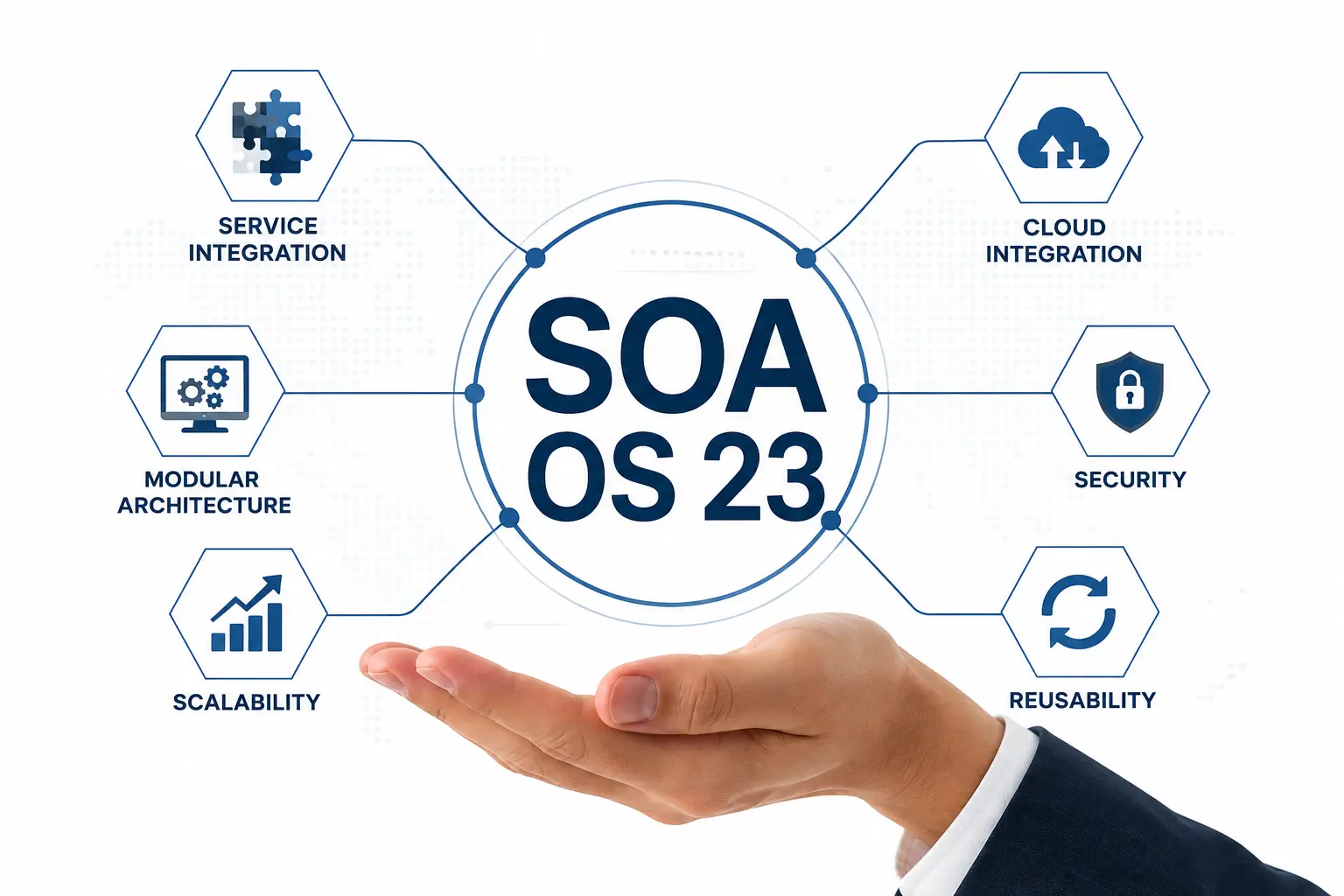
SOA OS 23: What It Is, Features, Benefits, Architecture & Uses
Introduction
Modern enterprises frequently face the challenge of managing complex applications, databases, APIs, and cloud systems that are tightly interwoven, making maintenance, upgrades, and integration difficult. SOA OS 23 addresses this challenge through a service-oriented approach that focuses on modularity, integration, and reusable services.
Understanding SOA OS 23 can help businesses evaluate how service-based architecture supports flexibility, scalability, integration, and easier system management.
The term SOA OS 23 is used here to describe a service-oriented approach to enterprise software architecture. It should not be confused with a specific operating system unless the term refers to a particular product or platform.
What Is SOA OS 23?
**What Is SOA OS 23?** SOA OS 23 is a service-oriented approach that breaks complex enterprise software into smaller, reusable services that communicate via APIs or defined interfaces and allow applications to exchange data or complete tasks seamlessly.
SOA OS 23 explained In its simplest terms, it is a modular architecture that reduces unnecessary dependencies between applications, helping businesses improve integration, flexibility, scalability, and maintenance while making complex enterprise systems simpler to manage.
Why SOA OS 23 Matters for Enterprise Architecture
SOA OS 23 can support modern enterprise architecture by breaking applications down into smaller services that are easier to manage and adapt than larger systems.
- Scalability: Services can be scaled independently when demand increases.
- Flexibility: Organisations may update or replace individual services without disrupting the entire system.
- Integration: Independent services can connect using standard interfaces, making it simpler to link different applications together.
- Maintainability: Smaller services tend to be simpler to monitor, test, troubleshoot, and update.
- Reusability: Services that can be reused across applications reduce development efforts and duplication, saving both time and money.
How Does SOA OS 23 Work?
The basic flow can be understood as:
Business requirement → Service → API/interface → Communication → Application → Result
Business Requirement: Businesses often need specific functions within their company, such as payment processing or customer verification. When this need arises, a dedicated service can be developed to manage the function efficiently.
API/Interface: The service offers an API or interface that enables other applications to request and use its functionality.
Communication: Applications communicate with the service by sending requests and receiving responses through its defined interface.
Application: An application uses the service to complete its required business process.
Result: Once the request is processed, the service returns the relevant information and results back to the application.
Service-Based Architecture
Service-based architecture divides an application’s functionality into individual services that each perform specific business functions, for example, payment processing and customer verification. These services can operate independently yet communicate through APIs or defined interfaces, making it easier to develop, update, maintain, and scale, as changes to one service don’t necessarily require changes across all other areas of an app.
Communication between services
APIs: APIs allow different services to communicate and request specific functions or data from one another.
Service Interfaces: Service interfaces define how a service can be accessed, as well as the information it can provide or receive.
Data Exchange: Services exchange data through structured formats, allowing applications to share relevant information efficiently.
Requests and Responses: One service sends out a request, while another service processes the request and responds with the required information.
Integration With Enterprise Systems
Service-oriented approaches can assist enterprises in connecting multiple systems through services and APIs.
- Legacy Applications: Existing systems can connect with modern applications without having to completely replace their old software.
- Databases: Services can access and exchange data across different databases and applications.
- Cloud Services: Cloud-based services can integrate with enterprise applications through APIs.
- Internal Business Applications: Different departments can link their applications and share required data and functionalities with each other.
- External APIs: Businesses can connect to third-party APIs to use external platforms and services and expand their existing capabilities.
SOA OS 23 Features
SOA OS 23 uses a service-oriented approach to make enterprise systems more modular, interconnected, and straightforward to manage. Key features of SOA OS 23 include:
| Feature | What It Means |
|---|---|
| Modularity | Divides systems into manageable services. |
| Reusability | Allows services to be used across applications. |
| Scalability | Individual services can scale according to demand. |
| Interoperability | Helps different systems communicate. |
| Loose Coupling | Reduces dependencies between components. |
| Integration | Connects different enterprise systems. |
| Maintainability | Makes updates and troubleshooting easier. |
Benefits of SOA OS 23 for Enterprise Systems
SOA OS 23 benefits include using modular, service-based architecture to make enterprise systems simpler to scale, modify, integrate, and maintain. Instead of treating an application as one large system, businesses can manage individual services according to their specific requirements.
Improved Scalability
Individual services may be scaled as demand grows without needing to completely redesign their systems, enabling businesses to focus resources where they’re most needed.
Greater Flexibility
Modular services enable businesses to more quickly adjust, modify, replace and improve specific functions. Businesses can adapt individual services without making major modifications to the overall app.
Better system integration
Service-based architecture allows various applications, platforms, databases and cloud systems to communicate through APIs or standard interfaces to form one cohesive enterprise system. This facilitates effective collaboration across enterprise systems.
Reduced Maintenance Complexity
Independent services make troubleshooting, testing and updating easier by allowing teams to focus on individual services rather than investigating changes across an entire system.
Service Reusability
Reusable services provide support to multiple applications and business processes, thus eliminating duplicated work for development projects, which in turn saves both time and resources in terms of time spent developing them and resources consumed during implementation.
Service Provider
Service providers design and manage services that perform specific business functions. They make these available via APIs or defined interfaces so other applications can access them.
Service consumer
Service providers design and manage services that perform specific business functions.
Applications, systems, or users act as service consumers when they request functionality through APIs or defined interfaces and receive the appropriate response.
A service registry, when used, helps consumers discover available services and their interfaces.
Service Registry
In architectures that use a service registry, it helps consumers discover available services and their interfaces.
Service interfaces
Service interfaces define how services interact with other applications. They detail how requests can be submitted and what kinds of data are exchanged between applications.
Data and Integration Layer
The data and integration layer facilitates information movement among services, databases, and enterprise applications. It supports communication across different systems as well as data exchange across them.
Simple Architecture Diagram
Service Consumer → Service Interface/API → Service → Integration Layer → Database/Enterprise System
SOA OS 23 Use Cases and Real-World Applications
SOA OS 23 can be utilized by businesses across industries when connecting multiple applications, services and data sources. Its service-oriented architecture can improve integration while making complex systems simpler to manage.
Banking and finance services
Banks can utilise service-based architecture for payment services, customer systems and account services, as well as to link fraud detection tools with transaction systems in order to detect suspicious activities more easily.
Healthcare Systems
Healthcare organisations can connect patient systems, appointment platforms, hospital applications and data sources in order to facilitate information sharing between various healthcare systems. This makes sharing easier between them.
E-Commerce
E-commerce platforms can separate product management, payment processing, inventory control, and customer management into individual services.
Government and Public Services
Government organisations can utilize services to connect citizen portals, databases, and legacy systems, creating better data sharing while allowing older systems to function with newer applications.
SOA OS 23 vs Traditional Monolithic Architecture
| Factor | SOA OS 23 | Monolithic Architecture |
| Structure | Service-based | Single application |
| Scalability | Individual services can scale | Usually scales as a whole |
| Maintenance | More modular | Can become complex |
| Reusability | High potential | More limited |
| Integration | Designed around services | Often tightly integrated |
| Updates | Service-level changes possible | Larger application changes may be required |
When Is SOA OS 23 Appropriate?
Service-based architecture may be suitable for large and complex enterprises that need scalability, system integration, service reusability and frequent updates. It can also prove invaluable when multiple departments or applications must share services.
When Is Monolithic Architecture Appropriate?
Monolithic architecture may be appropriate for smaller applications or projects with simple needs, without complex systems that need independent service scaling requirements. When this approach works well, developing and managing one application becomes simpler.
Challenges and Limitations of SOA OS 23
Although SOA OS 23 can bring many advantages, its implementation also presents its own set of difficulties and must meet specific technical and organisational criteria. Recognising these limitations helps businesses assess if this approach best meets their technical and organisational requirements.
Implementation complexity
Service-based systems require meticulous planning, architecture design, and coordination by organisations. When setting up service-based systems, organisations need to determine how services should be separated out and communicate with each other.
Service management
As more independent services increase monitoring and management requirements, teams may need to monitor service performance, availability, dependencies, and failures more closely.
Security
Organisations need to take extra precautions when providing services and interfaces that require authentication, authorisation, encryption and access controls in order to protect services and data.
Performance Overhead
Communication among separate services can incur extra network calls and latency; poorly designed communication patterns could compromise overall application performance.
Governance
Organisations require consistent standards for APIs, services, data formats, security, and access control in order to maintain reliable services that remain safe and compatible as their system grows. Good governance helps ensure this happens.
Operational Cost and Complexity
Managing multiple services can require additional monitoring, deployment, infrastructure, and development resources. Organisations should consider these costs before moving from a simpler architecture.
SOA OS 23 and the Future of Enterprise Architecture
Modern enterprise architecture increasingly relies on connected, distributed, and API-driven systems. SOA OS 23 may align with some of these trends; however, it should not be treated as being equivalent to all modern architectures.
- Cloud-Native Systems: Service-based approaches can support cloud environments by enabling applications to use independently managed services that can be deployed and scaled as needed.
- API-Driven Applications: APIs offer an organised framework for services and applications to interact, making them an important component of modern service-orientated systems.
- Microservices: Service-orientated approaches and microservices share principles such as modularity, independent services, and API-based communication. However, SOA and microservices are not identical architectural models. Microservices generally emphasise smaller services that can be deployed independently and use decentralised practices.
- Enterprise Systems with AI Capabilities: Services can bring AI capabilities, such as data analysis, recommendations, or automation, directly into enterprise applications through APIs.
- Hybrid Cloud: Service-based architecture can help organisations connect on-premises systems with cloud services, making it easier to integrate multiple environments.
- Automation: Businesses can integrate independent services with automated workflows to streamline manual processes and improve operational efficiency.
- Distributed Applications: Services can operate across different systems, servers, or cloud environments while communicating through predefined interfaces, allowing applications to work across distributed infrastructure.
Frequently Asked Questions About SOA OS 23
What Is SOA OS 23?
SOA OS 23 is a service-oriented approach that separates enterprise functions into individual services. These services communicate through APIs or interfaces, helping applications share data and functionality more efficiently.
What are the main SOA OS23 features?
SOA OS 23 features include modularity, reusability, scalability, interoperability, loose coupling, integration, and maintainability. These features make enterprise systems easier to manage and update.
What are the benefits of SOA OS 23?
SOA OS 23 benefits include greater scalability, flexibility, integration, maintenance, and service reuse. Companies can manage individual services without making extensive changes to the entire system.
How Does SOA OS 23 Work?
SOA OS 23 works by separating business functions into individual services. Applications send requests through APIs or interfaces, while services process those requests and return the required results.
Where is SOA OS23 used?
SOA OS 23 can be used across banking, healthcare, e-commerce, government, and large enterprises. It can connect applications, databases, cloud services, and other business systems.
What is the difference between SOA and microservices?
SOA and microservices both use modular services, but they differ in scope and design philosophy. SOA often focuses on broader enterprise integration and shared services, while microservices typically use smaller, independently deployable services with greater decentralization.
Conclusion
SOA OS 23 provides a service-oriented approach for structuring complex enterprise systems around modular and reusable services. By using defined interfaces and APIs, services can communicate while reducing unnecessary dependencies between applications.
Its potential benefits include scalability, flexibility, interoperability, service reuse, and easier maintenance. However, organisations should also consider implementation complexity, security, governance, service management, performance overhead, and operational costs before adopting this approach.
Understanding the architecture, use cases, benefits, and limitations of SOA OS 23 can help businesses determine whether a service-oriented model fits their existing applications, cloud environments, APIs, and long-term technology requirements.